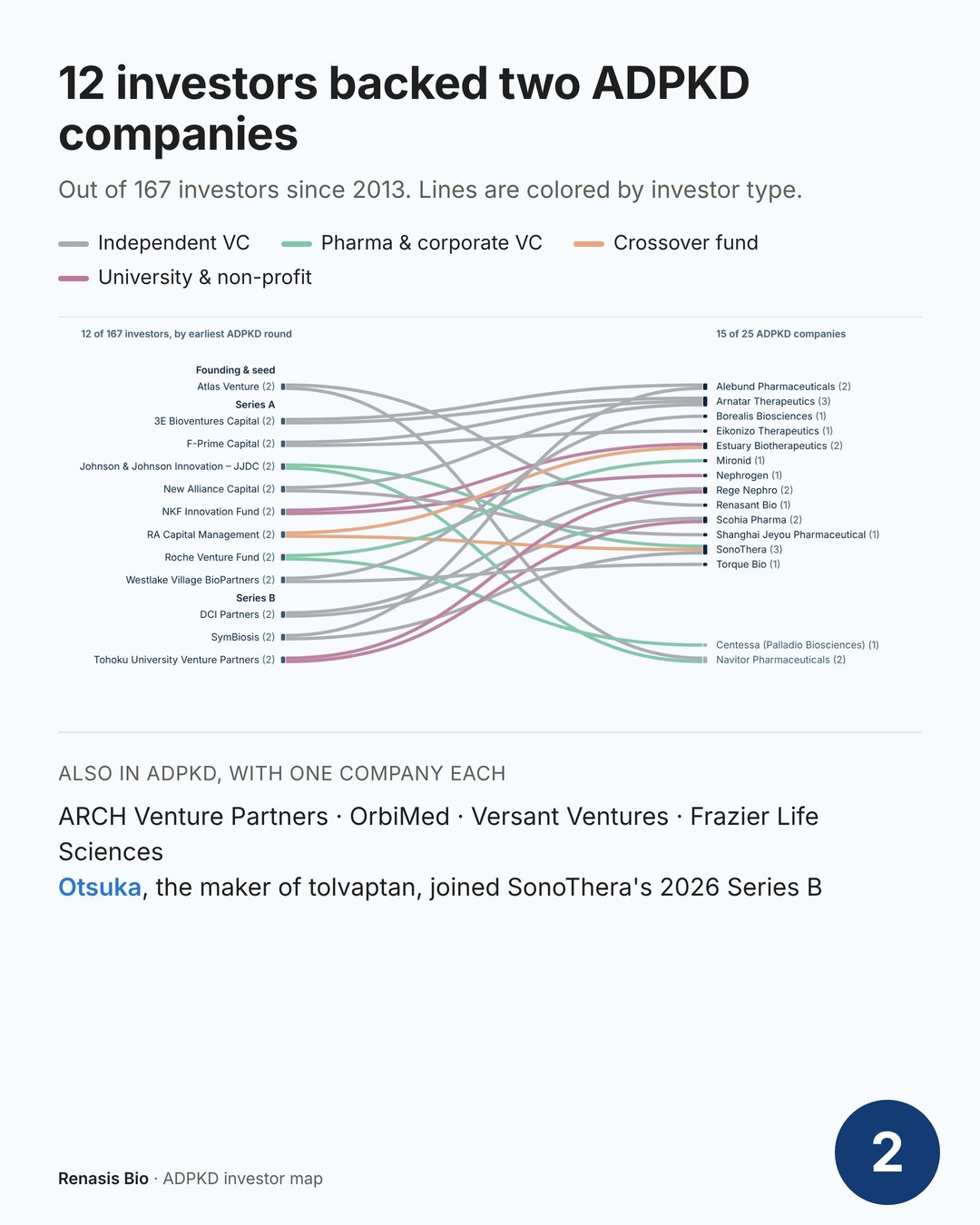
167 investors backed ADPKD companies over the past decade. 12 backed two.
Including:
- Roche Venture Fund: Mironid, Palladio
- Johnson & Johnson Innovation: SonoThera, Navitor (ADPKD asset sold to Janssen, part of J&J)
- Atlas Venture: Navitor, Renasant Bio
- RA Capital Management: Estuary Biotherapeutics, SonoThera
- F-Prime Capital: Arnatar, Eikonizo
Additional investments from top-tier VCs: ARCH Venture Partners, OrbiMed, Versant Ventures, Frazier Life Sciences.
And a telling one: Otsuka, the maker of tolvaptan, the only approved ADPKD drug, joined SonoThera's Series B in 2026.
Who
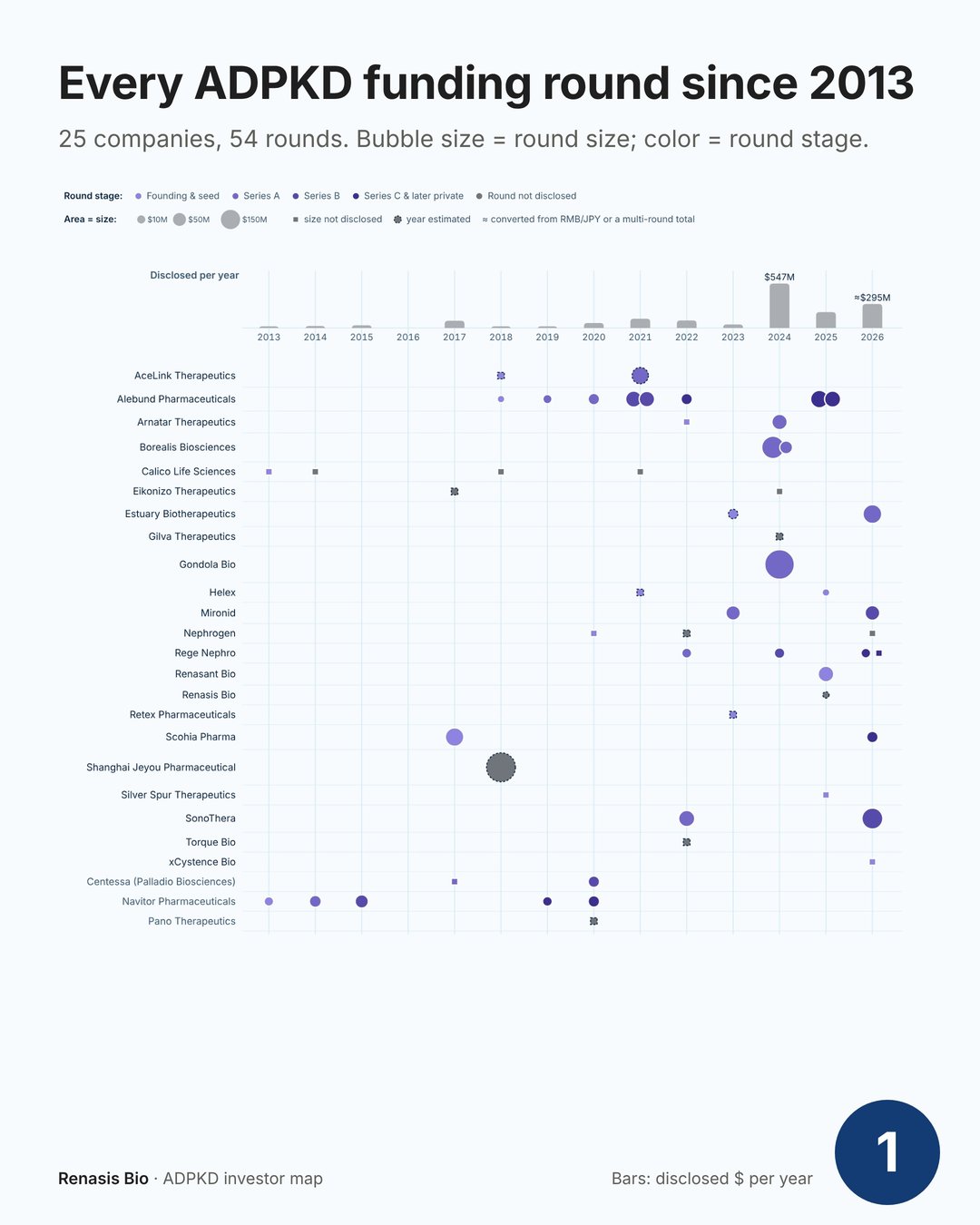
Claude and I mapped who backs ADPKD drug developers. Of about 40 companies with ADPKD programs, 25 have private funding we could trace: 167 investors across 54 rounds.
- 💼 104 VCs
- 🏢 37 CVCs
- 🎓 20 universities, foundations and public funds
- 🚀 6 accelerators
Why
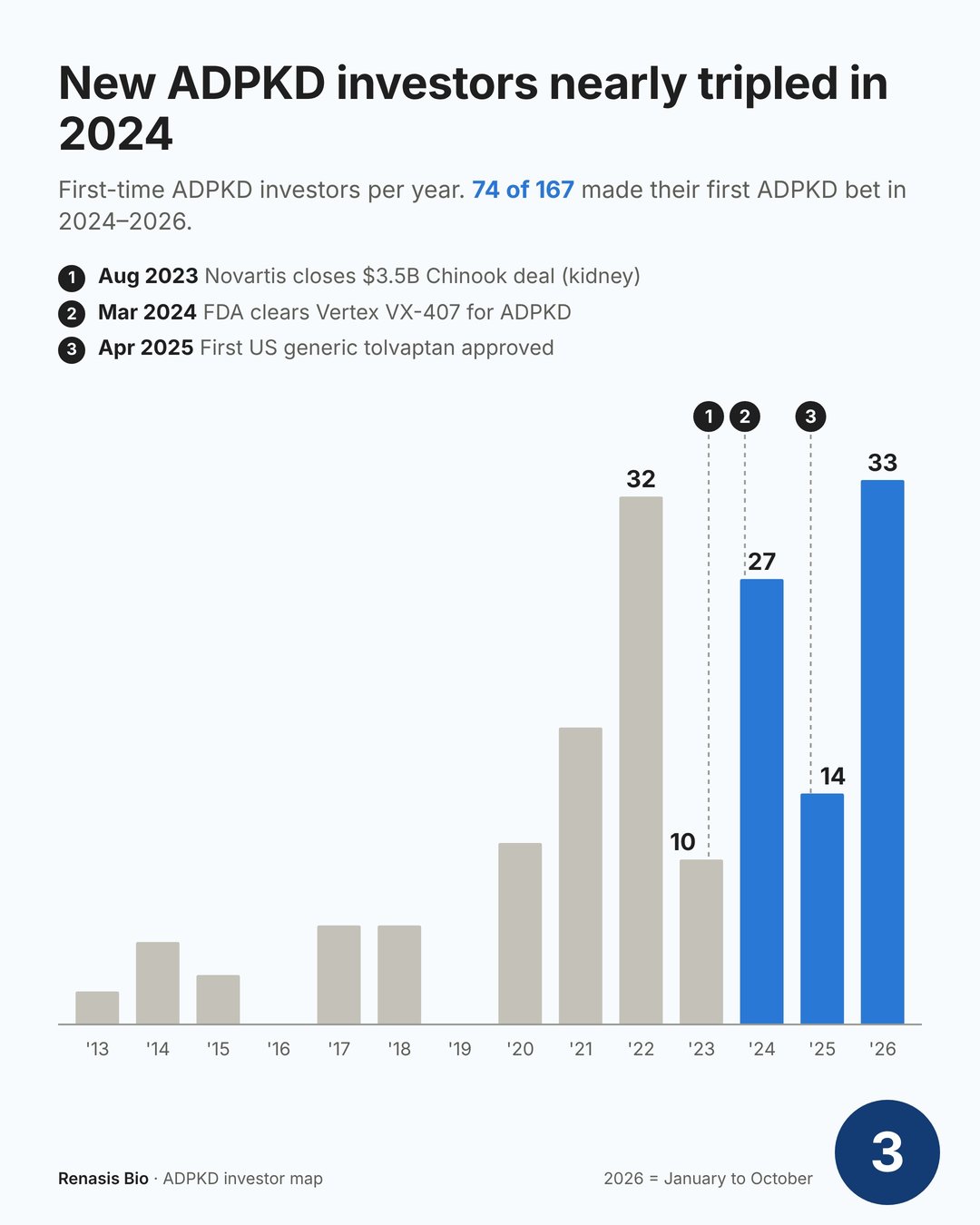
📈 The last three years brought more money and more investors than the decade before them: $0.85B in 2013–2023, $1.04B since.
What happened in 2023 to set this up? Three candidates, in order:
- Kidney became an M&A story. Novartis bought Chinook for $3.5B (Aug 2023), then Regulus for up to $1.7B (2025).
- Vertex moved in. Its PKD1 corrector VX-407 entered the clinic in 2024.
- Tolvaptan hit its peak and then went generic. $1.47B in US sales in 2024; first generic in 2025.
🇯🇵 Japan, tolvaptan's home country, is a great illustration of this trend. Two Japan-based biotechs, Rege Nephro and Scohia, have drawn 37 investors, and 22(!) of them have joined since 2024, as the drug peaked and went generic.
What
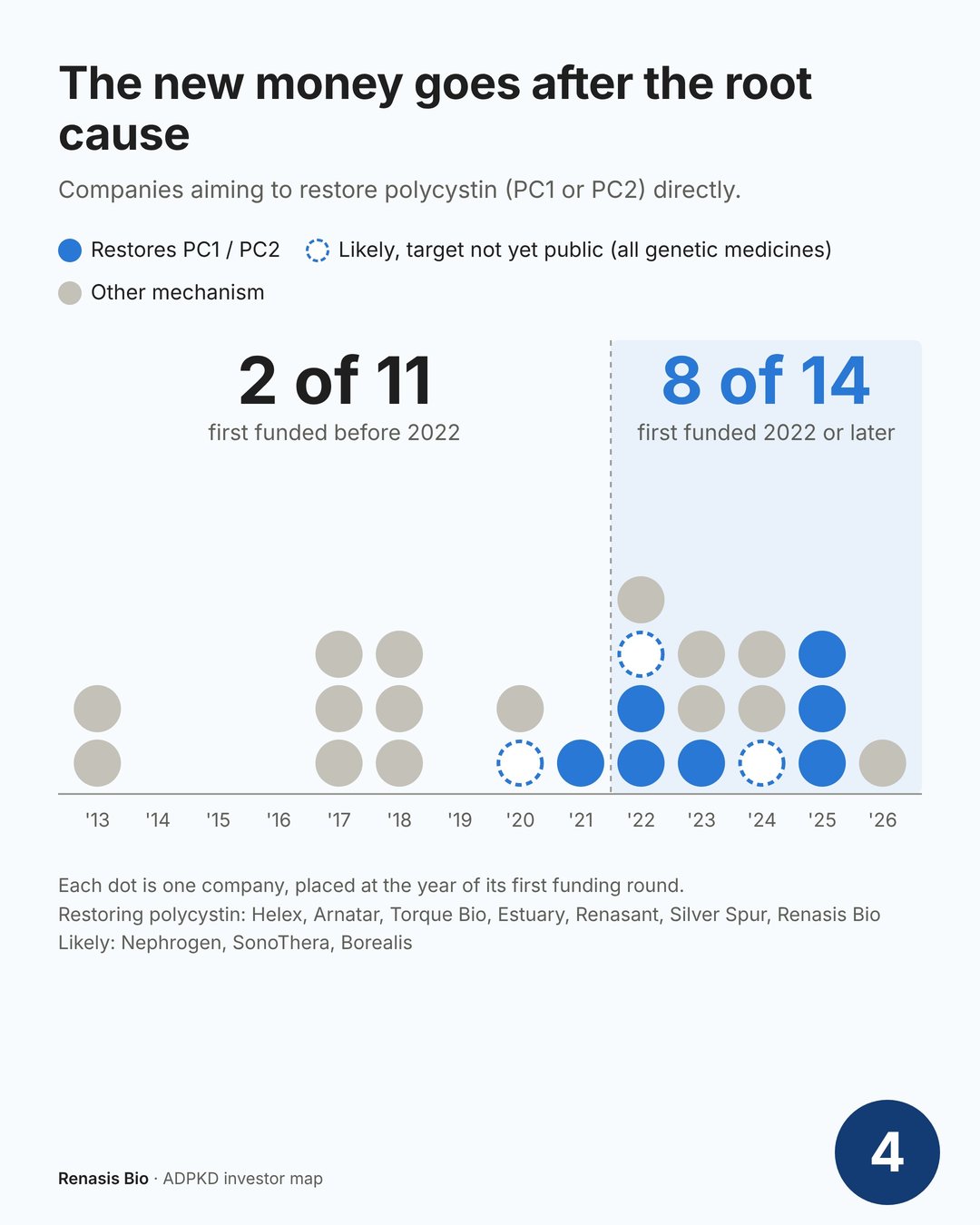
🎯 The new money is going after the root cause:
- 🌒 Before 2022: 2 out of 11 companies aimed to restore polycystin (PC1 or PC2) directly.
- 🌓 Since 2022: 8 out of 14.
When
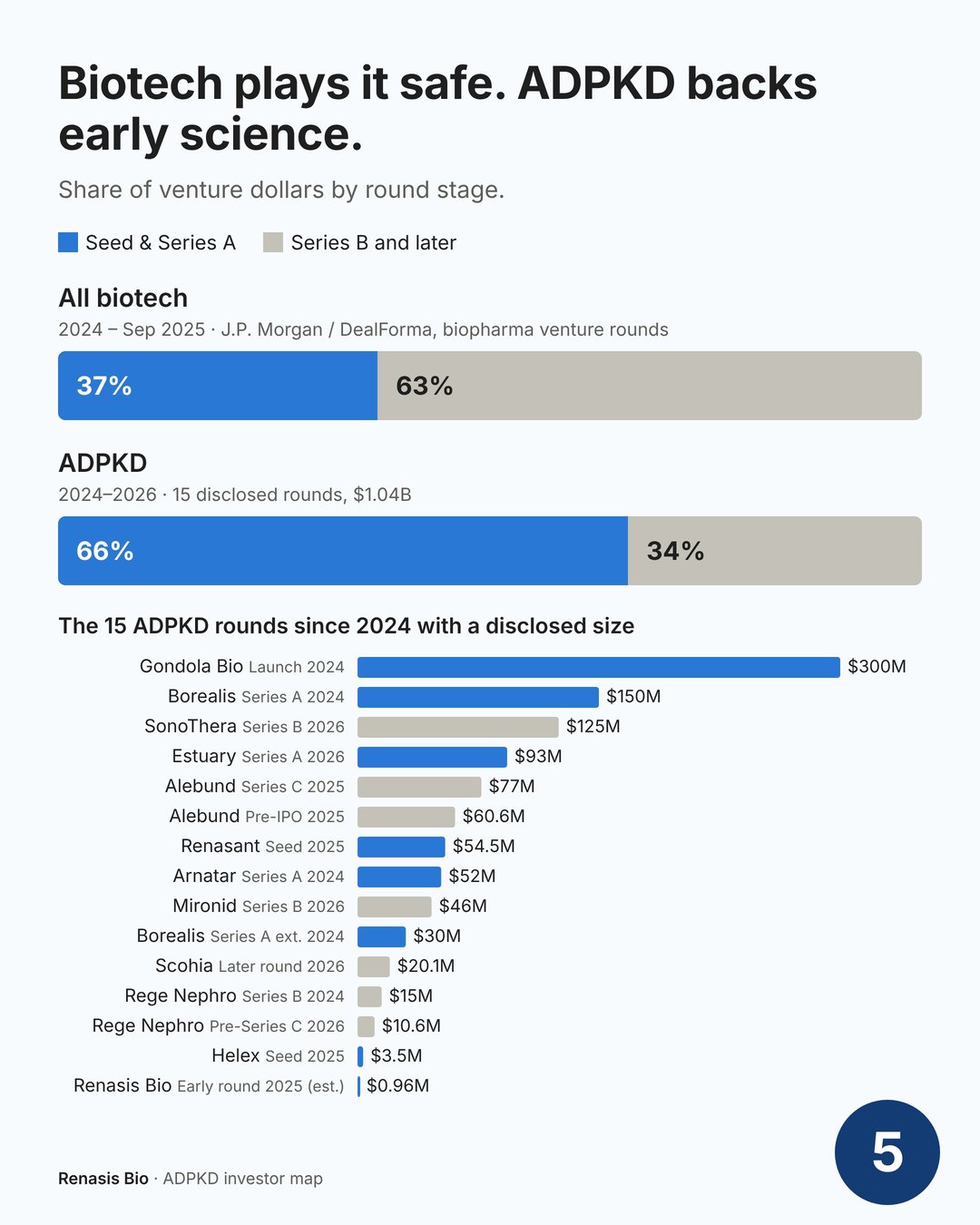
Across biotech, investors are playing it safe: in 2024–2025, only ~37% of venture dollars went to seed and Series A rounds. The rest went to later-stage companies.
🌱 ADPKD flips that. Since 2024, ~66% of ADPKD venture dollars went to seed and Series A rounds, like a $54.5M seed for Renasant Bio, a $93M Series A for Estuary and a $150M Series A for Borealis, all for programs still in preclinical.
To sum up
ADPKD is drawing serious investor interest, backing both established and novel modalities.
Most importantly, that means more shots on goal for patients, who today have just one approved drug, which does not treat the root cause and has severe side effects.
It also gives me hope for biotech more broadly: focused niches let single assets prove out whole platforms. At Renasis Bio, we strive to be in this group - having ADPKD as our lead program, spearheading our pipeline of RNA-upregulating small molecules.
Sources
- Investors, rounds and companies: the Renasis Bio ADPKD investors map (167 investors, 25 companies, 54 rounds), each round linked to its source; as CSV: rounds.csv, round_investors.csv, investor_profiles.csv
- Biotech seed and Series A share (37%, 2024 to Sep 2025): J.P. Morgan, Q3 2025 Biopharma Licensing and Venture Report (data: DealForma)
- Novartis–Chinook, up to $3.5B, closed Aug 11, 2023: Novartis
- Novartis–Regulus (farabursen for ADPKD), announced Apr 30, 2025, closed Jun 25, 2025: announcement, completion (Novartis)
- Vertex VX-407 IND cleared Mar 21, 2024: Vertex
- Jynarque (tolvaptan) US sales of $1,467M in 2024 and the first US generic tolvaptan, approved Apr 24, 2025: Lupin